# provider 6.1.5+1
A wrapper around InheritedWidget to make them easier to use and more reusable.
## Installing
```
export PUB_HOSTED_URL=https://pub.mirror.p-hatan.ir
flutter pub add 'provider:6.1.5+1'
```
Published: 2025-08-19T12:50:56.438080Z
Expected archive SHA-256: 4e82183fa20e5ca25703ead7e05de9e4cceed1fbd1eadc1ac3cb6f565a09f272
Available in cache; verification: upstream_checksum
## Direct dependencies
- collection: ^1.15.0
- flutter: map[sdk:flutter]
- nested: ^1.0.0
## Package README (untrusted upstream documentation)
[English](https://github.com/rrousselGit/provider/blob/master/packages/provider/README.md) | [French](https://github.com/rrousselGit/provider/blob/master/resources/translations/fr_FR/README.md) | [Português](https://github.com/rrousselGit/provider/blob/master/resources/translations/pt_br/README.md) | [简体中文](https://github.com/rrousselGit/provider/blob/master/resources/translations/zh-CN/README.md) | [Español](https://github.com/rrousselGit/provider/blob/master/resources/translations/es_MX/README.md) | [한국어](https://github.com/rrousselGit/provider/blob/master/resources/translations/ko-KR/README.md) | [বাংলা](https://github.com/rrousselGit/provider/blob/master/resources/translations/bn_BD/README.md) | [日本語](https://github.com/rrousselGit/provider/blob/master/resources/translations/ja_JP/README.md) | [Turkish](https://github.com/rrousselGit/provider/blob/master/resources/translations/tr_TR/README.md) | [Italian](https://github.com/rrousselGit/provider/blob/master/resources/translations/it_IT/README.md)
 [](https://codecov.io/gh/rrousselGit/provider)
 [
 ](https://flutter.dev/docs/development/packages-and-plugins/favorites)
A wrapper around [InheritedWidget]
to make them easier to use and more reusable.
By using `provider` instead of manually writing [InheritedWidget], you get:
- simplified allocation/disposal of resources
- lazy-loading
- a vastly reduced boilerplate over making a new class every time
- devtool friendly – using Provider, the state of your application will be visible in the Flutter devtool
- a common way to consume these [InheritedWidget]s (See [Provider.of]/[Consumer]/[Selector])
- increased scalability for classes with a listening mechanism that grows exponentially
in complexity (such as [ChangeNotifier], which is O(N) for dispatching notifications).
To read more about a `provider`, see its [documentation](https://pub.dev/documentation/provider/latest/provider/provider-library.html).
See also:
- [The official Flutter state management documentation](https://flutter.dev/docs/development/data-and-backend/state-mgmt/simple), which showcases how to use `provider` + [ChangeNotifier]
- [flutter architecture sample](https://github.com/brianegan/flutter_architecture_samples/tree/master/change_notifier_provider), which contains an implementation of that app using `provider` + [ChangeNotifier]
- [flutter_bloc](https://github.com/felangel/bloc) and [Mobx](https://github.com/mobxjs/mobx.dart), which uses a `provider` in their architecture
## Migration from 4.x.x to 5.0.0-nullsafety
- `initialData` for both `FutureProvider` and `StreamProvider` is now required.
To migrate, what used to be:
```dart
FutureProvider(
create: (context) => Future.value(42),
child: MyApp(),
)
Widget build(BuildContext context) {
final value = context.watch();
return Text('$value');
}
```
is now:
```dart
FutureProvider(
initialValue: null,
create: (context) => Future.value(42),
child: MyApp(),
)
Widget build(BuildContext context) {
// be sure to specify the ? in watch
final value = context.watch();
return Text('$value');
}
```
- `ValueListenableProvider` is removed
To migrate, you can instead use `Provider` combined with `ValueListenableBuilder`:
```dart
ValueListenableBuilder(
valueListenable: myValueListenable,
builder: (context, value, _) {
return Provider.value(
value: value,
child: MyApp(),
);
}
)
```
## Usage
### Exposing a value
#### Exposing a new object instance
Providers allow you to not only expose a value, but also create, listen, and dispose of it.
To expose a newly created object, use the default constructor of a provider.
Do _not_ use the `.value` constructor if you want to **create** an object, or you
may otherwise have undesired side effects.
See [this StackOverflow answer](https://stackoverflow.com/questions/52249578/how-to-deal-with-unwanted-widget-build)
which explains why using the `.value` constructor to create values is undesired.
- **DO** create a new object inside `create`.
```dart
Provider(
create: (_) => MyModel(),
child: ...
)
```
- **DON'T** use `Provider.value` to create your object.
```dart
ChangeNotifierProvider.value(
value: MyModel(),
child: ...
)
```
- **DON'T** create your object from variables that can change over time.
In such a situation, your object would never update when the
value changes.
```dart
int count;
Provider(
create: (_) => MyModel(count),
child: ...
)
```
If you want to pass variables that can change over time to your object,
consider using `ProxyProvider`:
```dart
int count;
ProxyProvider0(
update: (_, __) => MyModel(count),
child: ...
)
```
**NOTE**:
When using the `create`/`update` callback of a provider, it is worth noting that this callback
is called lazily by default.
This means that until the value is requested at least once, the `create`/`update` callbacks won't be called.
This behavior can be disabled if you want to pre-compute some logic, using the `lazy` parameter:
```dart
MyProvider(
create: (_) => Something(),
lazy: false,
)
```
#### Reusing an existing object instance:
If you already have an object instance and want to expose it, it would be best to use the `.value` constructor of a provider.
Failing to do so may call your object `dispose` method when it is still in use.
- **DO** use `ChangeNotifierProvider.value` to provide an existing
[ChangeNotifier].
```dart
MyChangeNotifier variable;
ChangeNotifierProvider.value(
value: variable,
child: ...
)
```
- **DON'T** reuse an existing [ChangeNotifier] using the default constructor
```dart
MyChangeNotifier variable;
ChangeNotifierProvider(
create: (_) => variable,
child: ...
)
```
### Reading a value
The easiest way to read a value is by using the extension methods on [BuildContext]:
- `context.watch()`, which makes the widget listen to changes on `T`
- `context.read()`, which returns `T` without listening to it
- `context.select(R cb(T value))`, which allows a widget to listen to only a small part of `T`.
One can also use the static method `Provider.of(context)`, which will behave similarly
to `watch`. When the `listen` parameter is set to `false` (as in `Provider.of(context, listen: false)`), then
it will behave similarly to `read`.
It's worth noting that `context.read()` won't make a widget rebuild when the value
changes and it cannot be called inside `StatelessWidget.build`/`State.build`.
On the other hand, it can be freely called outside of these methods.
These methods will look up in the widget tree starting from the widget associated
with the `BuildContext` passed and will return the nearest variable of type `T`
found (or throw if nothing is found).
This operation is O(1). It doesn't involve walking in the widget tree.
Combined with the first example of [exposing a value](#exposing-a-value), this widget will read the exposed `String` and render "Hello World."
```dart
class Home extends StatelessWidget {
@override
Widget build(BuildContext context) {
return Text(
// Don't forget to pass the type of the object you want to obtain to `watch`!
context.watch(),
);
}
}
```
Alternatively, instead of using these methods, we can use [Consumer] and [Selector].
These can be useful for performance optimizations or when it is difficult to
obtain a `BuildContext` descendant of the provider.
See the [FAQ](https://github.com/rrousselGit/provider#my-widget-rebuilds-too-often-what-can-i-do)
or the documentation of [Consumer](https://pub.dev/documentation/provider/latest/provider/Consumer-class.html)
and [Selector](https://pub.dev/documentation/provider/latest/provider/Selector-class.html)
for more information.
### Optionally depending on a provider
Sometimes, we may want to support cases where a provider does not exist. An
example would be for reusable widgets that could be used in various locations,
including outside of a provider.
To do so, when calling `context.watch`/`context.read`, make the generic type
nullable. Such that instead of:
```dart
context.watch()
```
which will throw a `ProviderNotFoundException` if no matching providers
are found, do:
```dart
context.watch()
```
which will try to obtain a matching provider. But if none are found,
`null` will be returned instead of throwing.
### MultiProvider
When injecting many values in big applications, `Provider` can rapidly become
pretty nested:
```dart
Provider(
create: (_) => Something(),
child: Provider(
create: (_) => SomethingElse(),
child: Provider(
create: (_) => AnotherThing(),
child: someWidget,
),
),
),
```
To:
```dart
MultiProvider(
providers: [
Provider(create: (_) => Something()),
Provider(create: (_) => SomethingElse()),
Provider(create: (_) => AnotherThing()),
],
child: someWidget,
)
```
The behavior of both examples is strictly the same. `MultiProvider` only changes
the appearance of the code.
### ProxyProvider
Since the 3.0.0, there is a new kind of provider: `ProxyProvider`.
`ProxyProvider` is a provider that combines multiple values from other providers into a new object and sends the result to `Provider`.
That new object will then be updated whenever one of the provider we depend on gets updated.
The following example uses `ProxyProvider` to build translations based on a counter coming from another provider.
```dart
Widget build(BuildContext context) {
return MultiProvider(
providers: [
ChangeNotifierProvider(create: (_) => Counter()),
ProxyProvider(
update: (_, counter, __) => Translations(counter.value),
),
],
child: Foo(),
);
}
class Translations {
const Translations(this._value);
final int _value;
String get title => 'You clicked $_value times';
}
```
It comes under multiple variations, such as:
- `ProxyProvider` vs `ProxyProvider2` vs `ProxyProvider3`, ...
That digit after the class name is the number of other providers that
`ProxyProvider` depends on.
- `ProxyProvider` vs `ChangeNotifierProxyProvider` vs `ListenableProxyProvider`, ...
They all work similarly, but instead of sending the result into a `Provider`,
a `ChangeNotifierProxyProvider` will send its value to a `ChangeNotifierProvider`.
### FAQ
#### Can I inspect the content of my objects?
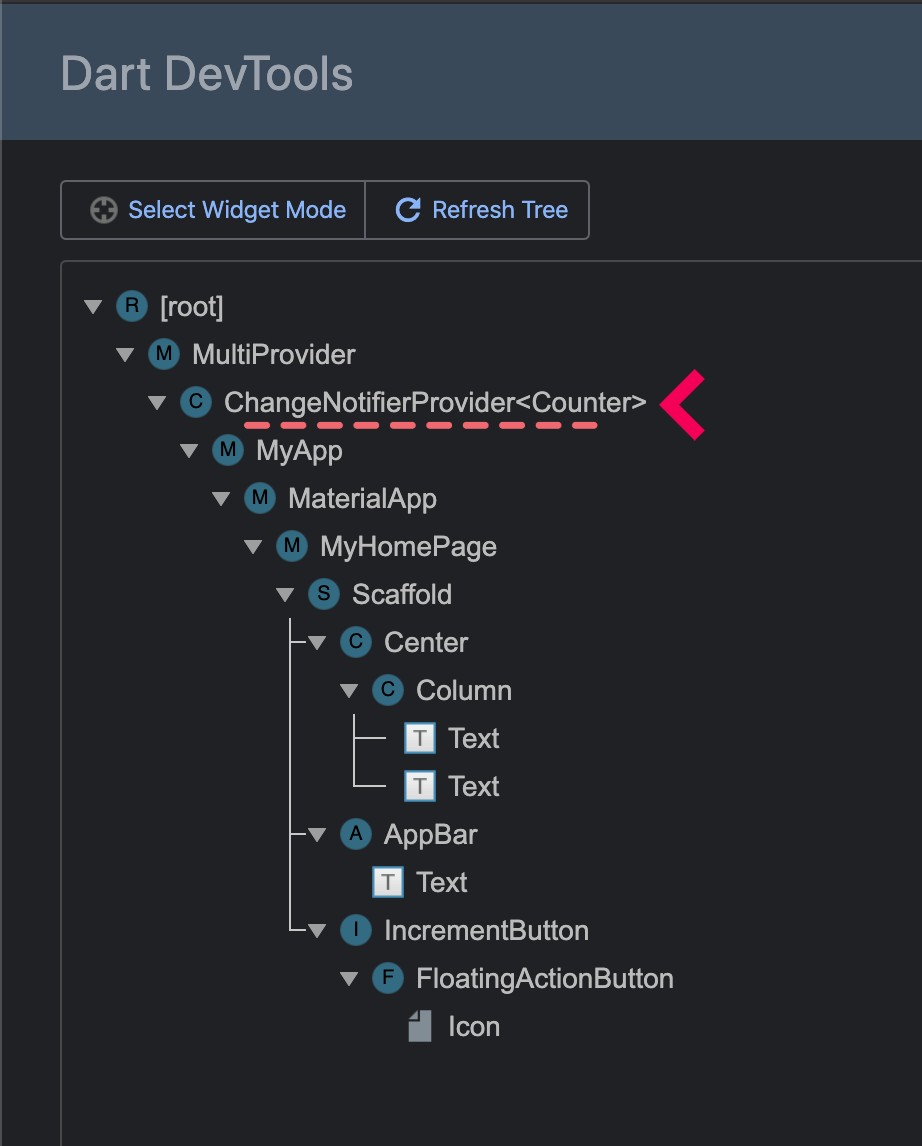
Flutter comes with a [devtool](https://github.com/flutter/devtools) that shows
what the widget tree is at a given moment.
Since providers are widgets, they are also visible in that devtool:
 From there, if you click on one provider, you will be able to see the value it exposes:
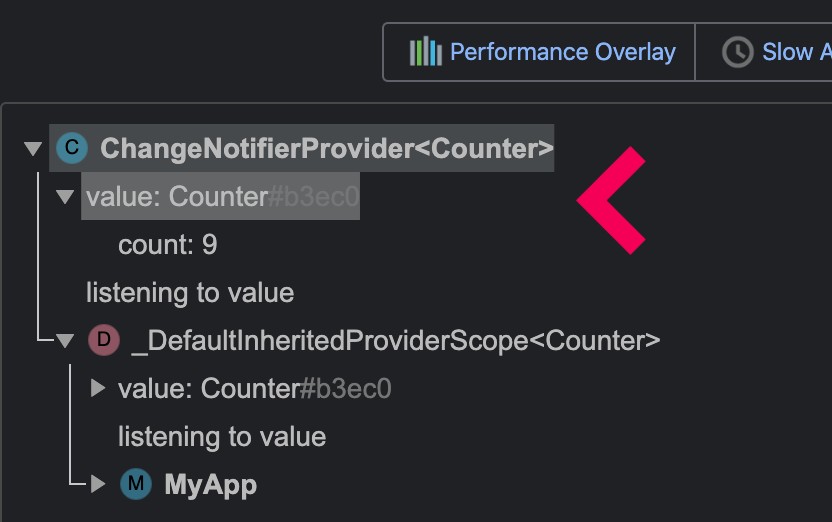 (screenshot of the devtools using the `example` folder)
#### The devtool only shows "Instance of MyClass". What can I do?
By default, the devtool relies on `toString`, which defaults to "Instance of MyClass".
To have something more useful, you have two solutions:
- use the [Diagnosticable](https://api.flutter.dev/flutter/foundation/Diagnosticable-mixin.html) API from Flutter.
For most cases, I will use [DiagnosticableTreeMixin] on your objects, followed by a custom implementation of [debugFillProperties](https://api.flutter.dev/flutter/foundation/DiagnosticableTreeMixin/debugFillProperties.html).
```dart
class MyClass with DiagnosticableTreeMixin {
MyClass({this.a, this.b});
final int a;
final String b;
@override
void debugFillProperties(DiagnosticPropertiesBuilder properties) {
super.debugFillProperties(properties);
// list all the properties of your class here.
// See the documentation of debugFillProperties for more information.
properties.add(IntProperty('a', a));
properties.add(StringProperty('b', b));
}
}
```
- Override `toString`.
If you cannot use [DiagnosticableTreeMixin] (like if your class is in a package
that does not depend on Flutter), then you can override `toString`.
This is easier than using [DiagnosticableTreeMixin] but is less powerful:
You will not be able to expand/collapse the details of your object.
```dart
class MyClass with DiagnosticableTreeMixin {
MyClass({this.a, this.b});
final int a;
final String b;
@override
String toString() {
return '$runtimeType(a: $a, b: $b)';
}
}
```
#### I have an exception when obtaining Providers inside `initState`. What can I do?
This exception happens because you're trying to listen to a provider from a
life-cycle that will never ever be called again.
It means that you either should use another life-cycle (`build`), or explicitly
specify that you do not care about updates.
As such, instead of:
```dart
initState() {
super.initState();
print(context.watch().value);
}
```
you can do:
```dart
Value value;
Widget build(BuildContext context) {
final value = context.watch().value;
if (value != this.value) {
this.value = value;
print(value);
}
}
```
which will print `value` whenever it changes (and only when it changes).
Alternatively, you can do:
```dart
initState() {
super.initState();
print(context.read().value);
}
```
Which will print `value` once _and ignore updates._
#### How to handle hot-reload on my objects?
You can make your provided object implement `ReassembleHandler`:
```dart
class Example extends ChangeNotifier implements ReassembleHandler {
@override
void reassemble() {
print('Did hot-reload');
}
}
```
Then used typically with `provider`:
```dart
ChangeNotifierProvider(create: (_) => Example()),
```
#### I use [ChangeNotifier], and I have an exception when I update it. What happens?
This likely happens because you are modifying the [ChangeNotifier] from one of its descendants _while the widget tree is building_.
A typical situation where this happens is when starting an http request, where the future is stored inside the notifier:
```dart
initState() {
super.initState();
context.read().fetchSomething();
}
```
This is not allowed because the state update is synchronous.
This means that some widgets may build _before_ the mutation happens (getting an old value), while other widgets will build _after_ the mutation is complete (getting a new value). This could cause inconsistencies in your UI and is therefore not allowed.
Instead, you should perform that mutation in a place that would affect the
entire tree equally:
- directly inside the `create` of your provider/constructor of your model:
```dart
class MyNotifier with ChangeNotifier {
MyNotifier() {
_fetchSomething();
}
Future _fetchSomething() async {}
}
```
This is useful when there's no "external parameter".
- asynchronously at the end of the frame:
```dart
initState() {
super.initState();
Future.microtask(() =>
context.read().fetchSomething(someValue);
);
}
```
It is slightly less ideal, but allows passing parameters to the mutation.
#### Do I have to use [ChangeNotifier] for complex states?
No.
You can use any object to represent your state. For example, an alternate
architecture is to use `Provider.value()` combined with a `StatefulWidget`.
Here's a counter example using such architecture:
```dart
class Example extends StatefulWidget {
const Example({Key key, this.child}) : super(key: key);
final Widget child;
@override
ExampleState createState() => ExampleState();
}
class ExampleState extends State {
int _count;
void increment() {
setState(() {
_count++;
});
}
@override
Widget build(BuildContext context) {
return Provider.value(
value: _count,
child: Provider.value(
value: this,
child: widget.child,
),
);
}
}
```
where we can read the state by doing:
```dart
return Text(context.watch().toString());
```
and modify the state with:
```dart
return FloatingActionButton(
onPressed: () => context.read().increment(),
child: Icon(Icons.plus_one),
);
```
Alternatively, you can create your own provider.
#### Can I make my Provider?
Yes. `provider` exposes all the small components that make a fully-fledged provider.
This includes:
- `SingleChildStatelessWidget`, to make any widget works with `MultiProvider`.
This interface is exposed as part of `package:provider/single_child_widget`
- [InheritedProvider], the generic `InheritedWidget` obtained when doing `context.watch`.
Here's an example of a custom provider to use `ValueNotifier` as the state:
https://gist.github.com/rrousselGit/4910f3125e41600df3c2577e26967c91
#### My widget rebuilds too often. What can I do?
Instead of `context.watch`, you can use `context.select` to listen only to the specific set of properties on the obtained object.
For example, while you can write:
```dart
Widget build(BuildContext context) {
final person = context.watch();
return Text(person.name);
}
```
It may cause the widget to rebuild if something other than `name` changes.
Instead, you can use `context.select` to listen only to the `name` property:
```dart
Widget build(BuildContext context) {
final name = context.select((Person p) => p.name);
return Text(name);
}
```
This way, the widget won't unnecessarily rebuild if something other than `name` changes.
Similarly, you can use [Consumer]/[Selector]. Their optional `child` argument allows rebuilding only a particular part of the widget tree:
```dart
Foo(
child: Consumer(
builder: (_, a, child) {
return Bar(a: a, child: child);
},
child: Baz(),
),
)
```
In this example, only `Bar` will rebuild when `A` updates. `Foo` and `Baz` won't
unnecessarily rebuild.
#### Can I obtain two different providers using the same type?
No. While you can have multiple providers sharing the same type, a widget will be able to obtain only one of them: the closest ancestor.
Instead, it would help if you explicitly gave both providers a different type.
Instead of:
```dart
Provider(
create: (_) => 'England',
child: Provider(
create: (_) => 'London',
child: ...,
),
),
```
Prefer:
```dart
Provider(
create: (_) => Country('England'),
child: Provider(
create: (_) => City('London'),
child: ...,
),
),
```
#### Can I consume an interface and provide an implementation?
Yes, a type hint must be given to the compiler to indicate the interface will be consumed, with the implementation provided in create.
```dart
abstract class ProviderInterface with ChangeNotifier {
...
}
class ProviderImplementation with ChangeNotifier implements ProviderInterface {
...
}
class Foo extends StatelessWidget {
@override
build(context) {
final provider = Provider.of(context);
return ...
}
}
ChangeNotifierProvider(
create: (_) => ProviderImplementation(),
child: Foo(),
),
```
### Existing providers
`provider` exposes a few different kinds of "provider" for different types of objects.
The complete list of all the objects available is [here](https://pub.dev/documentation/provider/latest/provider/provider-library.html)
| name | description |
| ----------------------------------------------------------------------------------------------------------------------------- | ---------------------------------------------------------------------------------------------------------------------------------------------------------------------- |
| [Provider](https://pub.dartlang.org/documentation/provider/latest/provider/Provider-class.html) | The most basic form of provider. It takes a value and exposes it, whatever the value is. |
| [ListenableProvider](https://pub.dartlang.org/documentation/provider/latest/provider/ListenableProvider-class.html) | A specific provider for Listenable object. ListenableProvider will listen to the object and ask widgets which depend on it to rebuild whenever the listener is called. |
| [ChangeNotifierProvider](https://pub.dartlang.org/documentation/provider/latest/provider/ChangeNotifierProvider-class.html) | A specification of ListenableProvider for ChangeNotifier. It will automatically call `ChangeNotifier.dispose` when needed. |
| [ValueListenableProvider](https://pub.dartlang.org/documentation/provider/latest/provider/ValueListenableProvider-class.html) | Listen to a ValueListenable and only expose `ValueListenable.value`. |
| [StreamProvider](https://pub.dartlang.org/documentation/provider/latest/provider/StreamProvider-class.html) | Listen to a Stream and expose the latest value emitted. |
| [FutureProvider](https://pub.dartlang.org/documentation/provider/latest/provider/FutureProvider-class.html) | Takes a `Future` and updates dependents when the future completes. |
### My application throws a StackOverflowError because I have too many providers, what can I do?
If you have a very large number of providers (150+), it is possible that some devices will throw a `StackOverflowError` because you end-up building too many widgets at once.
In this situation, you have a few solutions:
- If your application has a splash-screen, try mounting your providers over time instead of all at once.
You could do:
```dart
MultiProvider(
providers: [
if (step1) ...[
,
],
if (step2) ...[
]
],
)
```
where during your splash screen animation, you would do:
```dart
bool step1 = false;
bool step2 = false;
@override
initState() {
super.initState();
Future(() {
setState(() => step1 = true);
Future(() {
setState(() => step2 = true);
});
});
}
```
- Consider opting out of using `MultiProvider`.
`MultiProvider` works by adding a widget between every providers. Not using `MultiProvider` can
increase the limit before a `StackOverflowError` is reached.
## Sponsors

[provider.of]: https://pub.dev/documentation/provider/latest/provider/Provider/of.html
[selector]: https://pub.dev/documentation/provider/latest/provider/Selector-class.html
[consumer]: https://pub.dev/documentation/provider/latest/provider/Consumer-class.html
[changenotifier]: https://api.flutter.dev/flutter/foundation/ChangeNotifier-class.html
[inheritedwidget]: https://api.flutter.dev/flutter/widgets/InheritedWidget-class.html
[inheritedprovider]: https://pub.dev/documentation/provider/latest/provider/InheritedProvider-class.html
[diagnosticabletreemixin]: https://api.flutter.dev/flutter/foundation/DiagnosticableTreeMixin-mixin.html
## Changelog
## 6.1.5+1 - 2025-08-19
Updated Discord link.
## 6.1.5 - 2025-04-29
Fix a bug where a bug reading another provider may obtain the wrong value.
## 6.1.4 - 2025-03-27
Fix `MultiProvider` not being inheritable anymore due to 6.1.3.
## 6.1.3 - 2025-03-26 (retracted)
- Significantly increase the number of providers that MultiProvider can create at once without causing a `StackOverflow`.
## 6.1.2 - 2024-02-28
- Fixed an issue with `Selector` not rebuilding when the `builder` listens
to InheritedWidgets (thanks to @spkersten)
## 6.1.1
- Fix missing devtool assets
## 6.1.0
- The package now comes with a devtool extension enabled.
## 6.1.0-dev.1
- Fix missing folder in devtool extension
## 6.1.0-dev.0
- Moved the implementation of the devtool extension
in the source of Provider (thanks to @kenzieschmoll)
## 6.0.5
- Fix broken links on pub.dev
## 6.0.4
Fix typos and broken links in the documentation
## 6.0.3
- fix late initialization error when using `debugPrintRebuildDirtyWidgets`
- slightly reduced the binary size of release mode applications using provider
- Fix typos in the error message of ProviderNotFoundException
- improve performances for reading providers (thanks to @jiahaog)
## 6.0.2
Added error details for provider that threw during the creation (thanks to @jmewes)
## 6.0.1
Removed the assert that prevented from using `ChangeNotifierProvider`
with notifiers that already had listeners.
## 6.0.0
- **Breaking**: It is no longer possible to define providers where their
only difference is the nullability of the exposed value:
```dart
MultiProvider(
providers: [
Provider(...),
Provider(...)
]
)
```
Before, when defining those providers, doing `context.watch`
vs `context.watch` would point to a different provider.
Now, both will always point to the deepest provider (in this example `Provider`).
That fixes issues where a common developer mistake is to define a provider
as `Model?` but try to read it as `Model`. Previously, that would give a `ProviderNotFoundException`.
Now, this will correctly resolve the value.
That also helps large codebase migrate to null-safety progressively, as
they would temporarily contain both null-safe and unsound code. Previously,
unsound code would be unable to read a provider defined as `Provider`,
as `Model?` is not a valid syntax. With this change, this is now feasible.
- It is now possible to read a provider without throwing a `ProviderNotFoundException`
if the provider is optional.
To do so, when calling `context.watch`/`context.read`, make the generic type
nullable. Such that instead of:
```dart
context.watch()
```
which will throw a `ProviderNotFoundException` if no matching providers are found,
do:
```dart
context.watch()
```
which will try to obtain a matching provider. But if none are found,
`null` will be returned instead of throwing.
## 6.0.0-dev
- **Breaking**: It is no longer possible to define providers where their
only difference is the nullability of the exposed value:
```dart
MultiProvider(
providers: [
Provider(...),
Provider(...)
]
)
```
Before, when defining those providers, doing `context.watch`
vs `context.watch` would point to a different provider.
Now, both will always point to the deepest provider (in this example `Provider`).
That fixes issues where a common developer mistake is to define a provider
as `Model?` but try to read it as `Model`. Previously, that would give a `ProviderNotFoundException`.
Now, this will correctly resolve the value.
That also helps large codebase migrate to null-safety progressively, as
they would temporarily contain both null-safe and unsound code. Previously,
unsound code would be unable to read a provider defined as `Provider`,
as `Model?` is not a valid syntax. With this change, this is now feasible.
- It is now possible to read a provider without throwing a `ProviderNotFoundException`
if the provider is optional.
To do so, when calling `context.watch`/`context.read`, make the generic type
nullable. Such that instead of:
```dart
context.watch()
```
which will throw a `ProviderNotFoundException` if no matching providers are found,
do:
```dart
context.watch()
```
which will try to obtain a matching provider. But if none are found,
`null` will be returned instead of throwing.
## 5.0.0
- Stable, null-safe release.
- pre-release of the mechanism for state-inspection using the Flutter devtool
- Updated oudated doc in `StreamProvider`
## 5.0.0-nullsafety.5
Fixed an issue where providers with an `update` parameter in sound null-safety mode could throw null exceptions.
## 5.0.0-nullsafety.4
- Upgraded `nested` dependency to 1.0.0 and `collection` to 1.15.0
## 5.0.0-nullsafety.3
- Improved the error message of `ProviderNotFoundException` to mention hot-reload. (#595)
- Removed the asserts that prevented `ChangeNotifier`s in `ChangeNotifierProvider()`
to have listeners (#596)
- Removed the opinionated asserts in `context.watch`/`context.read`
that prevented them to be used inside specific conditions (#585)
## 5.0.0-nullsafety.2
- Improved the error message when an exception is thrown inside `create` of a provider`
## 5.0.0-nullsafety.1
- Reintroduced `ValueListenableProvider.value` (the default constructor is still removed).
## 5.0.0-nullsafety.0
Migrated Provider to non-nullable types:
- `initialData` for both `FutureProvider` and `StreamProvider` is now required.
To migrate, what used to be:
```dart
FutureProvider(
create: (context) => Future.value(42),
child: MyApp(),
)
Widget build(BuildContext context) {
final value = context.watch();
return Text('$value');
}
```
is now:
```dart
FutureProvider(
initialValue: null,
create: (context) => Future.value(42),
child: MyApp(),
)
Widget build(BuildContext context) {
// be sure to specify the ? in watch
final value = context.watch();
return Text('$value');
}
```
- `ValueListenableProvider` is removed
To migrate, you can instead use `Provider` combined with `ValueListenableBuilder`:
```dart
ValueListenableBuilder(
valueListenable: myValueListenable,
builder: (context, value, _) {
return Provider.value(
value: value,
child: MyApp(),
);
}
)
```
## 4.3.3
- Improved the error message of `ProviderNotFoundException` to mention hot-reload. (#595)
- Removed the asserts that prevented `ChangeNotifier`s in `ChangeNotifierProvider()`
to have listeners (#596)
- Removed the opinionated asserts in `context.watch`/`context.read`
that prevented them to be used inside specific conditions (#585)
## 4.3.2+4
`ValueListenableProvider` is no-longer deprecated.
Only its default constructor is deprecated (the `.value` constructor is kept)
## 4.3.2+3
Marked `ValueListenableProvider` as deprecated
## 4.3.2+2
Improve pub score
## 4.3.2+1
Documentation improvement about the `builder` parameter of Providers.
## 4.3.2
Fixed typo in the error message of `ProviderNotFoundException`
## 4.3.1
- Fixed a bug where hot-reload forced all lazy-loaded providers to be computed.
## 4.3.0
- Added `ReassembleHandler` interface, for objects to implement so that
`provider` let them handle hot-reload.
## 4.2.0
- Added a `builder` parameter on `MultiProvider` (thanks to @joaomarcos96):
```dart
MultiProvider(
providers: [
ChangeNotifierProvider(create: (ct) => Counter()),
],
builder: (ctx, child) {
final counter = ctx.watch();
return Text('${counter.count}');
},
);
```
## 4.1.3+1
- Small Readme changes
## 4.1.3
- Improved the error message of `ProviderNotFoundException` with instructions
that better fit what is usually the problem.
- Added documentation on why `context.read` should not be called inside `build`,
and what to do instead.
- Improved the performances of `context.select`, by not calling the selectors
when the provider changes if the widgets listening to the value are already
needing build.
- Fixes a bug where `context.watch` couldn't be called inside `ListView`/`LayoutBuilder`
- Improve the error message when trying to use `context.select` inside `ListView.builder`
- Improve the error message when calling `context.read/watch/select`/`Provider.of` with
a `context` that is `null`.
## 4.1.2
- Loosened the constraint on Flutter's version to be compatible with `beta` channel.
## 4.1.1
- Fixes an "aspect" leak with `context.select`, leading to memory leaks and unnecessary rebuilds
- Fixes the `builder` parameter of providers not working (thanks to @passsy)
## 4.1.0
- Now requires:
- Flutter >= 1.6.0
- Dart >= 2.7.0
- Added a `select` extension on `BuildContext`. It behaves similarly to `Selector`,
but is a lot less verbose to write:
With Selector:
```dart
Widget build(BuildContext context) {
return Selector(
selector: (_, p) => p.name,
builder: (_, name, __) {
return Text(name);
},
),
}
```
VS with the new `select` extension:
```dart
Widget build(BuildContext context) {
final name = context.select((Person p) => p.name);
return Text(name);
}
```
- Added `builder` on the different providers.
This parameter simplifies situations where we need a [BuildContext] that
can access the new provider.
As such, instead of:
```dart
Provider(
create: (_) => Something(),
child: Builder(
builder: (context) {
final name = context.select((Something s) => s.name);
return Text(name);
},
),
)
```
we can write:
```dart
Provider(
create: (_) => Something(),
builder: (context, child) {
final name = context.select((Something s) => s.name);
return Text(name);
},
)
```
The behavior is the same. This is only a small syntax sugar.
- Added a two extensions on [BuildContext], to slightly reduce the boilerplate:
| before | after |
| ---------------------------------------- | ------------------- |
| `Provider.of(context, listen: false)` | `context.read()` |
| `Provider.of(context)` | `context.watch` |
- Added a `Locator` typedef and an extension on [BuildContext], to help with
being able to read providers from a class that doesn't depend on Flutter.
## 4.0.5+1
- Added Português translation of the readme file (thanks to @robsonsilv4)
## 4.0.5
- Improve error message when forgetting to pass a `child` when using a provider outside of `MultiProvider` (thanks to @felangel)
## 4.0.4
- Update the ProviderNotFoundException to remove outdated solution. (thanks @augustinreille)
## 4.0.3
- improved error message when `Provider.of` is called without specifying
`listen: false` outside of the widget tree.
## 4.0.2
- fix `Provider.of` returning the previous value instead of the new value
if called inside `didChangeDependencies`.
- fixed an issue where `update` was unnecessarily called.
## 4.0.1
- stable release of 4.0.0-hotfix+1
- fix some typos
## 4.0.0-hotfix.1
- removed the inference of the `listen` flag of `Provider.of` in favor of an exception in debug mode if `listen` is true when it shouldn't.
This is because it caused a critical performance issue. See https://github.com/rrousselGit/provider/issues/305
## 4.0.0
- `Selector` now deeply compares collections by default, and offers a `shouldRebuild`
to customize the rebuild behavior.
- renamed `ProviderNotFoundError` to `ProviderNotFoundException`.
This allows calling `Provider.of` inside a `try/catch` without triggering a
warning.
- update provider to work with Flutter 1.12.1
- The creation and listening of objects using providers is now performed lazily.
This means that objects are created the first time the value is read instead of
the first time the provider is mounted.
- ~~The `listen` argument of `Provider.of` is now automatically inferred.
It is no longer necessary to pass `listen: false` when calling `Provider.of`
outside of the widget tree.~~ removed by 4.0.0-hotfix. See https://github.com/rrousselGit/provider/issues/305
- renamed `initialBuilder` & `builder` of `*ProxyProvider` to `create` & `update`
- renamed `builder` of `*Provider` to `create`
- added a `*ProxyProvider0` variant
## 3.2.0
- Deprecated "builder" of providers in favor to "create"
- Deprecated "initialBuilder"/"builder" of proxy providers in favor of respectively
"create" and "update"
## 3.1.0
- Added `Selector`, similar to `Consumer` but can filter unneeded updates
- improved the overall documentation
- fixed a bug where `ChangeNotifierProvider.value` didn't update dependents
when the `ChangeNotifier` instance changed.
- `Consumer` can now be used inside `MultiProvider`
```dart
MultiProvider(
providers: [
Provider(builder: (_) => Foo()),
Consumer(
builder: (context, foo, child) =>
Provider.value(value: foo.bar, child: child),
)
],
);
```
## 3.0.0
### breaking (see the readme for migration steps)
- `Provider` now throws if used with a `Listenable`/`Stream`. This can be disabled by setting
`Provider.debugCheckInvalidValueType` to `null`.
- The default constructor of `StreamProvider` has now builds a `Stream`
instead of `StreamController`. The previous behavior has been moved to `StreamProvider.controller`.
- All `XXProvider.value` constructors now use `value` as parameter name.
- Added `FutureProvider`, which takes a future and updates dependents when the future completes.
- Providers can no longer be instantiated using `const` constructors.
### non-breaking
- Added `ProxyProvider`, `ListenableProxyProvider`, and `ChangeNotifierProxyProvider`.
These providers allows building values that depends on other providers,
without loosing reactivity or manually handling the state.
- Added `DelegateWidget` and a few related classes to help building custom providers.
- Exposed the internal generic `InheritedWidget` to help building custom providers.
## 2.0.1
- fix a bug where `ListenableProvider.value`/`ChangeNotifierProvider.value`
/`StreamProvider.value`/`ValueListenableProvider.value` subscribed/unsubscribed
to their respective object too often
- fix a bug where `ListenableProvider.value`/`ChangeNotifierProvider.value` may
rebuild too often or skip some.
## 2.0.0
- `Consumer` now takes an optional `child` argument for optimization purposes.
- merged `Provider` and `StatefulProvider`
- added a "builder" constructor to `ValueListenableProvider`
- normalized providers constructors such that the default constructor is a "builder",
and offer a `value` named constructor.
## 1.6.1
- `Provider.of` now crashes with a `ProviderNotFoundException` when no `Provider`
are found in the ancestors of the context used.
## 1.6.0
- new: `ChangeNotifierProvider`, similar to scoped_model that exposes `ChangeNotifer` subclass and
rebuilds dependents only when `notifyListeners` is called.
- new: `ValueListenableProvider`, a provider that rebuilds whenever the value passed
to a `ValueNotifier` change.
## 1.5.0
- new: Add `Consumer` with up to 6 parameters.
- new: `MultiProvider`, a provider that makes a tree of provider more readable
- new: `StreamProvider`, a stream that exposes to its descendants the current value of a `Stream`.
## 1.4.0
- Reintroduced `StatefulProvider` with a modified prototype.
The second argument of `valueBuilder` and `didChangeDependencies` have been removed.
And `valueBuilder` is now called only once for the whole life-cycle of `StatefulProvider`.
## 1.3.0
- Added `Consumer`, useful when we need to both expose and consume a value simultaneously.
## 1.2.0
- Added: `HookProvider`, a `Provider` that creates its value from a `Hook`.
- Deprecated `StatefulProvider`. Either make a `StatefulWidget` or use `HookProvider`.
- Integrated the widget inspector, so that `Provider` widget shows the current value.
## 1.1.1
- add `didChangeDependencies` callback to allow updating the value based on an `InheritedWidget`
- add `updateShouldNotify` method to both `Provider` and `StatefulProvider`
## 1.1.0
- `onDispose` has been added to `StatefulProvider`
- [BuildContext] is now passed to `valueBuilder` callback
[buildcontext]: https://api.flutter.dev/flutter/widgets/BuildContext-class.html